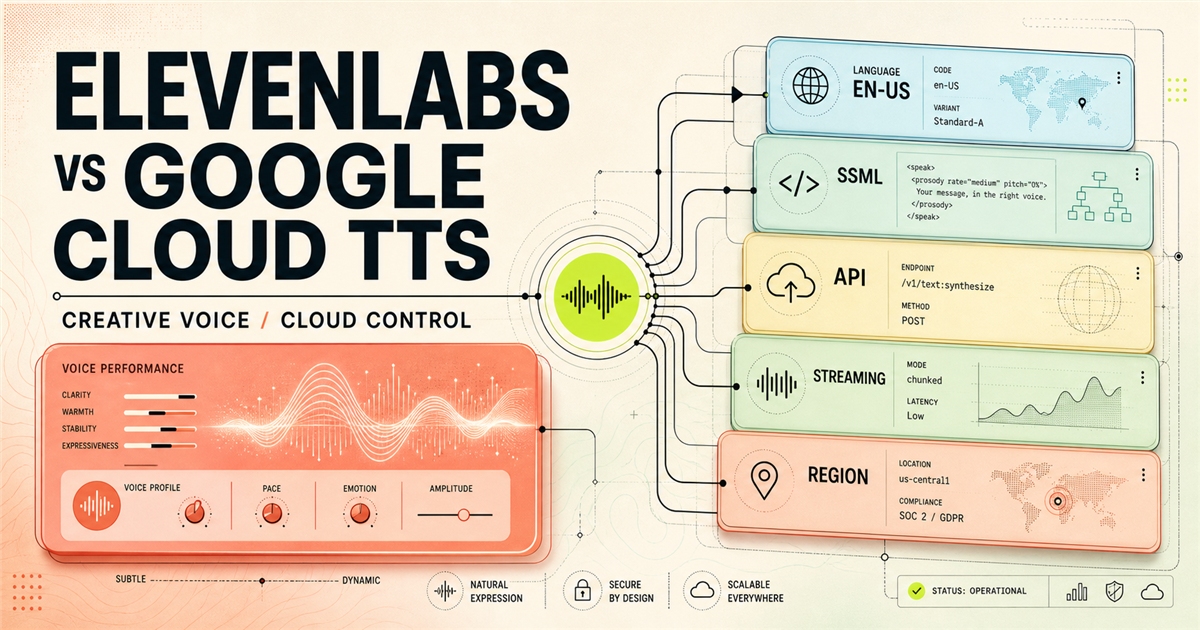
ElevenLabs vs Google Cloud Text-to-Speech looks like a voice-quality contest. It is really a choice between a creative voice platform and cloud speech infrastructure.
ElevenLabs helps you audition, design, clone, and direct voices. Google Cloud Text-to-Speech helps engineering teams synthesize audio across many languages, models, formats, and deployment rules inside Google Cloud.
My rule is simple: choose ElevenLabs when the voice itself must carry personality. Start with Google Cloud when language coverage, SSML, IAM, quotas, and an existing Google Cloud stack matter more than a friendly production desk.
These products remove different work
ElevenLabs removes creative work. Its product gives writers, editors, and developers a voice library, cloning, Voice Design, expressive models, dubbing, and a browser interface for producing audio. You can make something useful before building an application around it.
Google Cloud removes infrastructure work. It gives teams REST and gRPC APIs, client libraries, project-level access control, monitoring, regional endpoints, and a long catalog of voices. You can connect speech to the same operations already used for other Google Cloud services.
That distinction matters more than a polished demo. A YouTube producer may save hours by repairing delivery without asking an engineer. A platform team may save weeks by keeping credentials, billing alerts, audit practices, and deployment inside its existing cloud account.
ElevenLabs has the stronger creative workflow
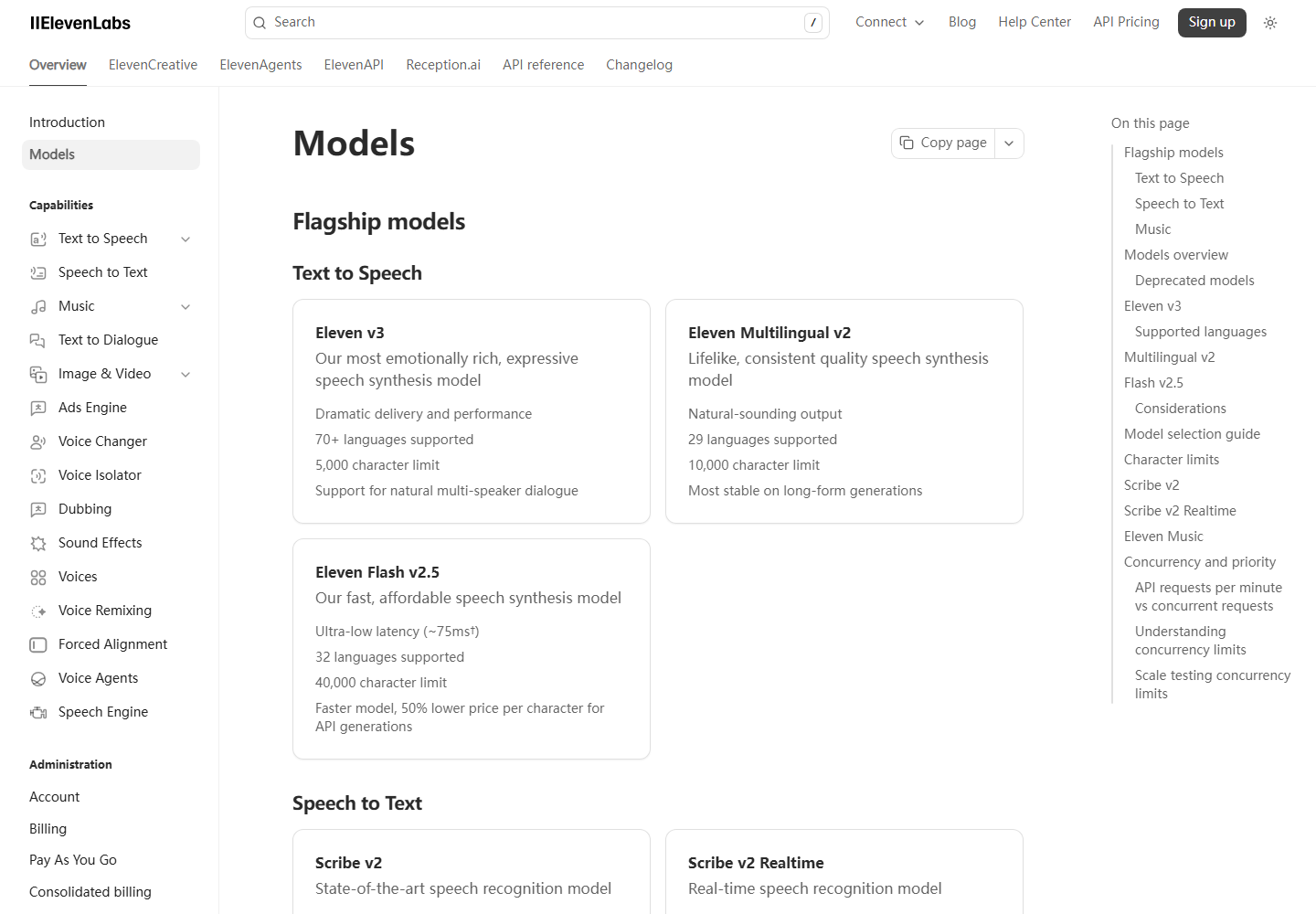
ElevenLabs is the better first stop for audiobooks, character dialogue, branded narration, localized campaigns, and documentary voiceovers. The current model range covers three different jobs:
- Eleven v3 aims for dramatic, emotionally rich delivery across more than 70 languages.
- Multilingual v2 favors stable, natural long-form generation across 29 languages.
- Flash v2.5 targets fast speech for real-time applications across 32 languages.
The voice catalog is the bigger advantage. ElevenLabs says its library now includes more than 10,000 voices, alongside instant cloning, professional cloning, and Voice Design. A producer can audition different accents and personalities without turning each change into an engineering ticket.
That freedom creates more choices. Voice, model, stability, pronunciation, pacing, and script segmentation can all change the result. One excellent paragraph does not prove that a 20-minute chapter will stay consistent.
When I evaluate a creative TTS tool, I use a script with a proper noun, an acronym, a price, an emotional turn, and a correction. I generate each difficult line five times. The best take shows the creative ceiling. The spread between takes shows the real editing burden.
Google Cloud is built for controlled deployment
Google Cloud Text-to-Speech is not trying to look like a creator studio. Its strengths show up in the documentation and the API surface: a broad list of language codes and regional variants, several voice families, multiple audio formats, long-audio jobs, streaming synthesis, and Google Cloud operations.
The current voice catalog includes Chirp 3 HD, Studio, Neural2, WaveNet, and Standard voices. They are not cosmetic tiers. They have different prices, intended uses, streaming support, and controls.
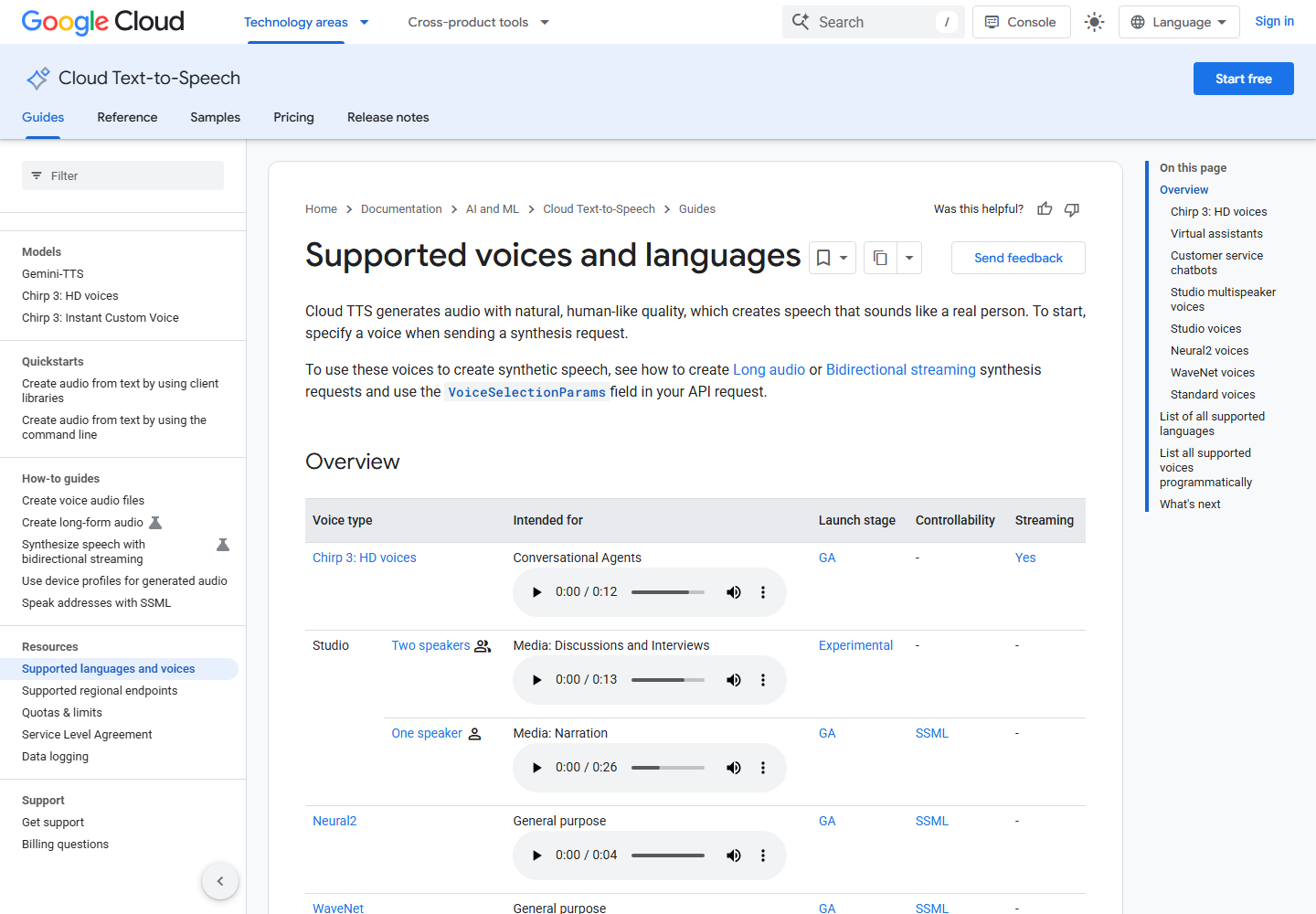
Chirp 3 HD supports low-latency bidirectional streaming, which suits conversational agents. It does not support SSML input, speaking-rate controls, or pitch controls. Neural2, WaveNet, Standard, and one-speaker Studio voices support SSML, although the exact tags vary by voice type.
This is the Google Cloud trap: saying “we need SSML and the newest voice” is not a complete requirement. The newest conversational model may remove controls that a legacy narration pipeline depends on. Pick the model after listing the controls, region, output format, and latency your application actually needs.
Voice quality depends on the job
For character work or a branded narrator, ElevenLabs has the higher creative ceiling. Eleven v3 can respond to emotional context and audio tags. The voice library makes auditions quick, and cloning gives a team a path to a recognizable sound, provided it has the speaker’s permission.
Google’s Chirp 3 HD voices can sound natural and work well in live applications, but the product gives you less of a creative playground. The advantage is a more structured technical catalog. A support bot may need reliable language coverage and fast streaming, not 200 ways to sound wistful.
Do not compare the tools with different scripts or different headphones. Use the same 12 test lines and level-match the output. Include names, addresses, dates, currency, abbreviations, short interjections, and one long paragraph. Ask a second listener to score clarity, naturalness, pronunciation, and fatigue without showing the vendor name.
If the voice is part of the brand, add a consistency test. Generate the same line five times and inspect pacing, emphasis, and timbre. A stunning outlier is not a production baseline.
SSML and pronunciation control
Google Cloud has the more traditional markup path. Supported voices accept SSML for pauses, dates, times, acronyms, and pronunciation behavior. You can also set pitch, speaking rate, volume, sample rate, and output encoding through the request, depending on the voice family.
ElevenLabs uses a different control model. Its expressive models respond to text context and audio tags, while pronunciation dictionaries handle recurring names and terms. Voice settings such as stability and similarity shape consistency. The approach feels more like directing a performance than writing markup.
Neither approach wins everywhere. SSML is easier to generate and review in a rules-based pipeline. ElevenLabs is better when an editor needs to shape emotion without maintaining a forest of tags. The awkward middle ground is a project that needs both strict pronunciation rules and highly expressive acting. Test the exact model, because the product name alone does not guarantee either behavior.
Developer workflow and operational overhead
ElevenLabs has a focused API and official JavaScript and Python SDKs. A request can be as small as a voice ID, model ID, text, and output format. The same account also exposes the creator tools, which helps when editors and developers share a voice workflow.
Google Cloud expects a project, billing setup, an enabled API, credentials, and the right access. That is more work for a solo creator. For an engineering organization already on Google Cloud, it may be exactly the control the security team wants.
Google also gives platform teams familiar places for quotas, logs, budget alerts, and service accounts. The downside is discoverability. Voice models, IAM roles, Vertex AI features, and classic Cloud TTS documentation can feel like neighboring streets with similar names. Write down the exact endpoint, model, project, and role before handing the integration to another team.
Streaming and latency need an end-to-end test
ElevenLabs advertises about 75ms of model inference for Flash v2.5, excluding network and application overhead. It supports streaming and is a credible choice for agents. Google offers bidirectional streaming for Chirp 3 HD and places those voices directly in the conversational-agent category.
Published model latency is not what a caller hears. The real path includes speech recognition, language-model generation, sentence buffering, TTS scheduling, network travel, and playback. A fast speech model cannot rescue an application that waits two seconds before sending a speakable phrase.
Measure from the end of the user’s turn to the first audible sound. Run at least 50 realistic requests from the target region, then record median, p95, and worst-case delay. Add interruptions and concurrent traffic. A clean solo request proves almost nothing about a Monday support queue.
ElevenLabs vs Google Cloud TTS pricing in 2026
I checked both vendors’ public pricing on July 23, 2026. Both charge by usage, but Google splits pricing across more model families.
ElevenLabs lists pay-as-you-go API rates of $0.05 per 1,000 characters for Flash and Turbo, and $0.10 per 1,000 characters for Multilingual v2 and v3. The current API pricing page lists a $6 Starter subscription and included character allowances that vary by model.
Google lists these character-based rates after each monthly free allowance:
- Chirp 3 HD: $30 per one million characters after one million free characters.
- Neural2: $16 per one million characters after one million free characters.
- Standard and WaveNet: $4 per one million characters after four million free characters.
- Studio: $160 per one million characters after one million free characters.
Google’s Gemini TTS models use token pricing instead, with no free usage allowance listed. That is another reason to record the exact model instead of budgeting for “Google TTS” as one line item.
The cheapest character rate may produce the most expensive finished minute if the voice needs heavy repair. Price a representative 10-minute script, then include rejected generations, storage, network costs, and editing time. Cost per approved minute beats cost per request.
What people complain about on Reddit
Reddit is useful for finding failure modes, not declaring a winner. The posts are anecdotes, user skill varies, and voice models change quickly.
The recurring ElevenLabs complaint is credit burn. In a May 2026 r/ElevenLabs thread, users questioned why balances seemed to fall faster and described extra iterations after model changes. ElevenLabs now publishes simpler pay-as-you-go API rates, but retakes still belong in a production budget.
A broader r/ElevenLabs pricing discussion captured the central tradeoff. Users pointed to Google’s much cheaper Standard tier, while others said lower-cost cloud voices sounded more robotic for their narration. That is not a controlled listening test. It is a useful warning that price and expressive quality can move in opposite directions.
Google Cloud complaints focus more on setup and billing confidence. In r/googlecloud, a nontechnical user found projects, billing accounts, free credits, and cost controls intimidating when they only wanted to try TTS. Another Chirp 3 HD user struggled to reconcile working requests with usage that was not visible in billing.
The common theme is clear. ElevenLabs users worry about the cost of creative iteration. Google Cloud users worry about configuring and observing a cloud service correctly. Put both risks in the trial plan.
Who should choose ElevenLabs
Choose ElevenLabs if:
- You produce audiobooks, games, documentaries, dubbed media, or branded narration.
- Editors need to audition, clone, design, and direct voices without engineering help.
- Emotional range matters more than the lowest character price.
- One team needs expressive long-form models and faster speech for live use.
- A dedicated voice workspace will remove file shuffling and approval delays.
Skip it if speech is a small utility inside a Google Cloud application and the large catalog would only create more choices. Also budget for retakes. A monthly allowance can disappear quickly when every important line gets four auditions.
Who should choose Google Cloud Text-to-Speech
Choose Google Cloud if:
- Your application already uses Google Cloud projects, service accounts, monitoring, and billing.
- Broad language and regional-variant coverage is a hard requirement.
- SSML, output formats, quotas, and infrastructure controls matter more than a creator interface.
- You need inexpensive Standard or WaveNet synthesis at large character volumes.
- Chirp 3 HD streaming fits a conversational agent and its control limits are acceptable.
Skip it if a writer expects to open a polished studio and direct a performance today. Google exposes the machinery. That is useful for a platform team and tiring for a solo producer.
Who should avoid both
Avoid both when text cannot leave your infrastructure, offline generation is mandatory, or open weights are a procurement requirement. A local model may fit better, but your team then owns deployment, scaling, monitoring, and pronunciation repair.
Neither service is a full podcast or video editor. If transcript repair, captions, timeline editing, and export consume most of the week, a production suite may save more time than either speech API.
My verdict
ElevenLabs wins when voice identity, cloning, expressive delivery, and a usable production workspace justify a higher per-character rate. Google Cloud Text-to-Speech wins when language coverage, SSML, cloud governance, and low-cost high-volume synthesis matter more than creative convenience.
For creator-led work, I would audition ElevenLabs first. For a multilingual application already running on Google Cloud, I would prototype the exact Google voice family first. Then I would generate the same script five times, measure first audio under load, and price only the takes that survive review.
If neither product fits cleanly, continue with my ElevenLabs alternatives 2026 guide. It compares creator studios, real-time APIs, cloud platforms, and local TTS by the work they actually remove.