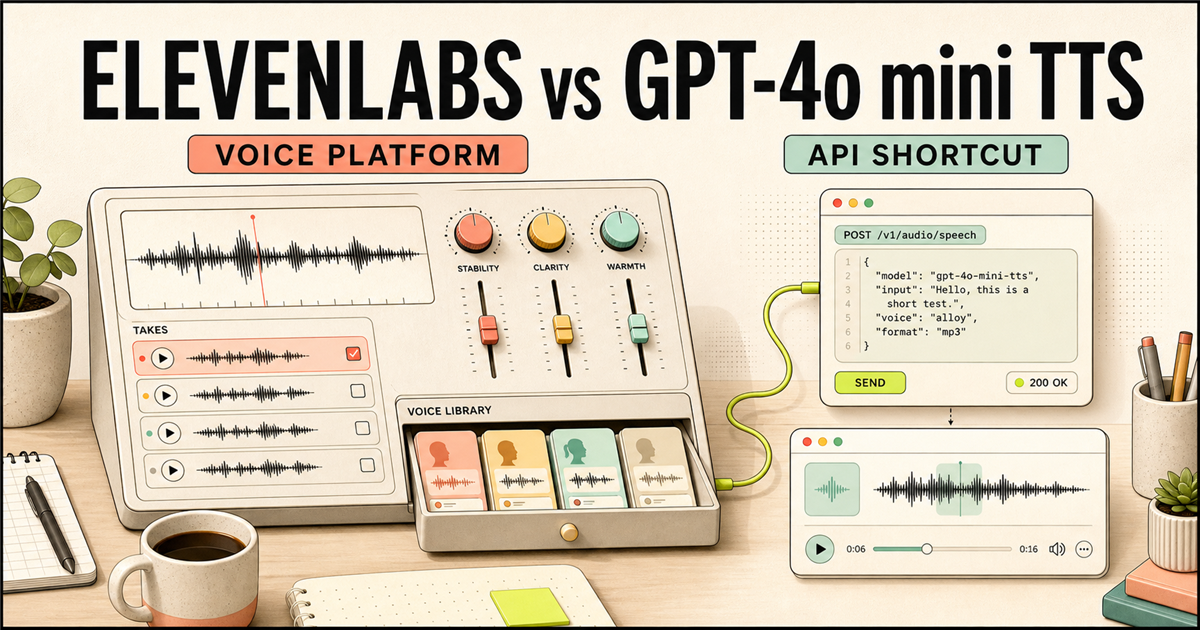
ElevenLabs vs OpenAI GPT-4o mini TTS sounds like a voice-quality contest. It is really a choice between a specialist voice platform and a speech endpoint inside a much larger AI stack.
ElevenLabs gives you a huge voice library, cloning, Voice Design, expressive models, dubbing, and tools for people who produce audio. GPT-4o mini TTS gives developers one compact API for turning text into instructed speech, with streaming and familiar OpenAI SDK patterns.
My rule is straightforward: choose ElevenLabs when the voice is part of the product’s identity. Start with OpenAI when speech is one output inside an app that already uses its API.
The products remove different kinds of work
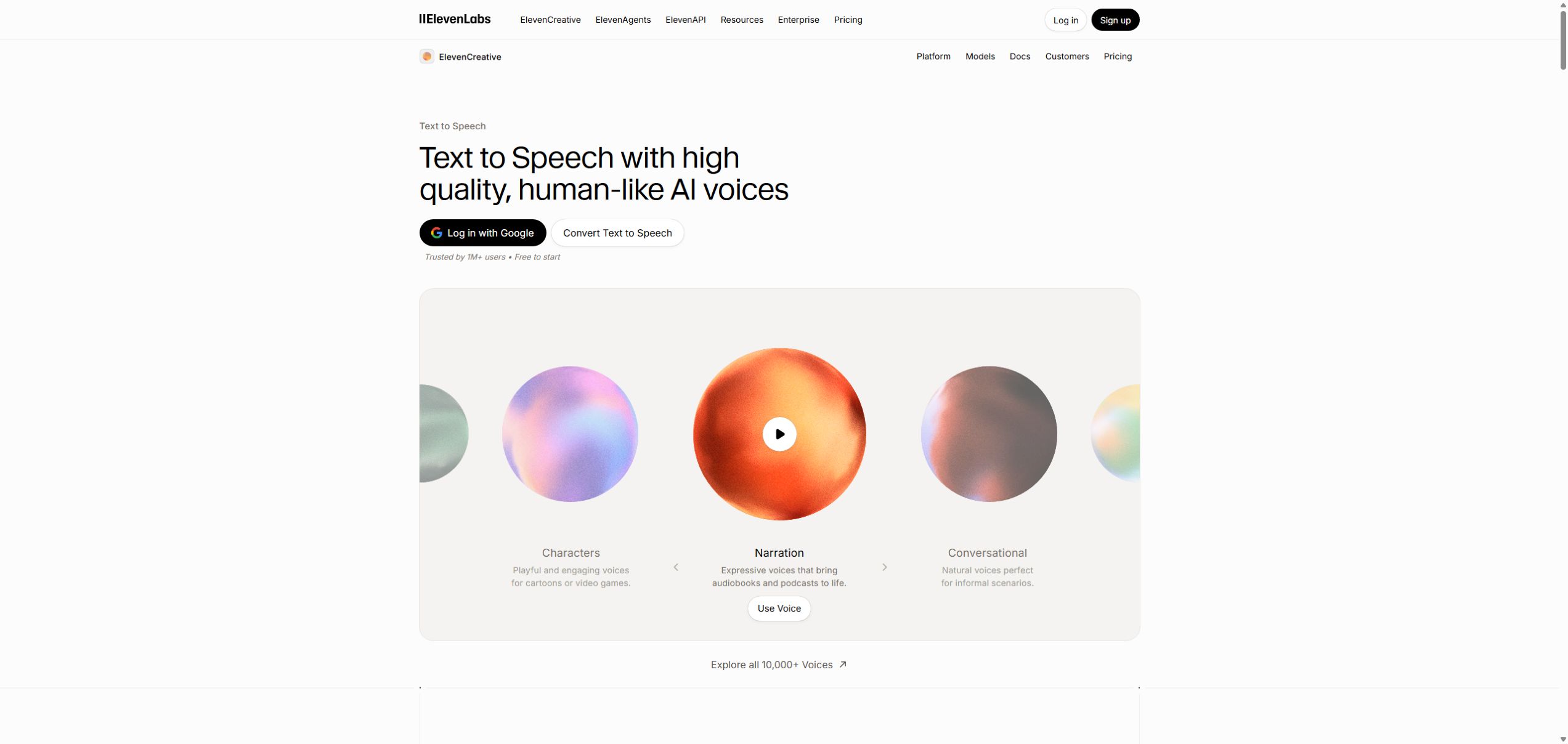
ElevenLabs removes creative production work. You can browse more than 10,000 voices, design or clone one, switch between expressive and low-latency models, and keep related audio jobs under one account. Its current text-to-speech page lists more than 70 languages for Eleven v3, while Flash v2.5 targets faster delivery across 32 languages.
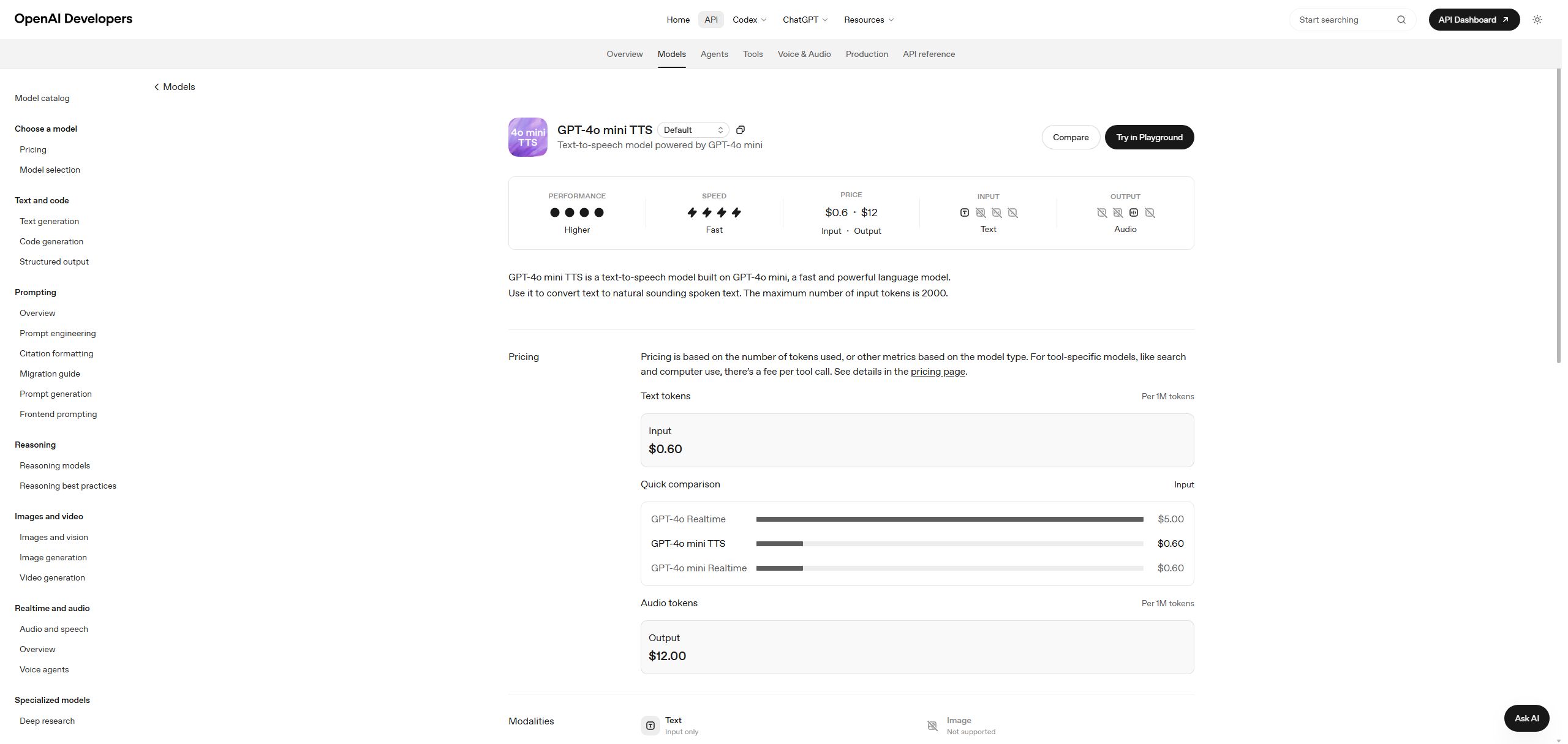
OpenAI removes integration work. The speech endpoint is v1/audio/speech, the request looks like the rest of the OpenAI API, and the current GPT-4o mini TTS model accepts up to 2,000 input tokens. You send text, choose a voice, add delivery instructions, and receive audio.
Neither advantage is cosmetic. A creator may save hours by finding the right voice and repairing a performance without rebuilding a pipeline. A product team may save a week by keeping authentication, billing, observability, and SDK conventions with a vendor it already uses.
ElevenLabs has the higher creative ceiling
ElevenLabs is the stronger first stop for audiobooks, character dialogue, documentary narration, localized campaigns, and branded voices. Eleven v3 supports emotional context and audio tags. Voice Design creates a voice from a description, while cloning lets a team preserve an approved sound across projects.
The model menu matters. Eleven v3 aims at expressive delivery. Multilingual v2 is the steadier long-form choice. Flash v2.5 is built for low-latency applications. One account can serve a game studio on Monday and a support agent on Tuesday, although those jobs should not share the same test plan.
The creative ceiling comes with more decisions. Voice, model, stability, pronunciation, pacing, and script segmentation all affect the result. A beautiful first clip does not guarantee a stable 20-minute chapter.
My editorial workflow would lock difficult names first, divide long narration into approved sections, and keep rejected takes in the cost estimate. If a line is emotionally important, generate it beside the lines around it. Isolated sentence repair often creates a small shift in pace or tone that becomes obvious after export.
OpenAI is the cleaner API shortcut
GPT-4o mini TTS is appealing when the application already asks an OpenAI model to write the response. The same backend can pass the final text to speech without adding a separate creator platform.
OpenAI’s current guide lists 13 built-in voices and supports instructions such as speaking warmly, quickly, or in a particular tone. Output formats include MP3, Opus, AAC, FLAC, WAV, and PCM. The API can stream audio with chunked transfer, and OpenAI recommends WAV or PCM when the fastest response matters.
There is one important boundary. The standard experience centers on built-in voices. Custom voices exist, but OpenAI says they are limited to eligible customers and require a consent recording plus a sample. An organization can create no more than 20 custom voices. That is not a drop-in replacement for ElevenLabs’ public voice marketplace or its broader self-serve cloning workflow.
OpenAI also requires clear disclosure that the voice is AI-generated. ElevenLabs has consent and usage rules of its own, especially around cloning. Whichever vendor you choose, document the speaker’s permission and make the synthetic nature of the audio clear to listeners.
Voice control versus repeatability
For a hero line, game character, or branded narrator, ElevenLabs gives you more ways to shape the performance. The library alone makes auditions quicker. Expressive tags and specialist models add headroom when “friendly” is not a detailed enough direction.
GPT-4o mini TTS offers useful instruction control, but its smaller voice catalog keeps the search space narrow. That can be a virtue inside a product. A support response needs to be clear and consistent, not auditioned against 80 near-matches every morning.
Do not judge either service with one polished paragraph. Build a test set with a difficult proper noun, an address, a price, an emotional turn, a correction, and a sentence long enough to expose pacing. Generate every item at least five times. The best result shows the ceiling. The spread between results shows how much editing and retry logic the project will need.
For production apps, pin a model snapshot when the provider allows it and retest before changing versions. OpenAI currently lists gpt-4o-mini-tts-2025-12-15 as a snapshot, while the earlier 2025-03-20 snapshot is deprecated. Version changes can improve the model and still alter a delivery that your team approved.
Developer workflow, streaming, and latency
OpenAI has the smaller integration surface if the rest of the application already runs there. One SDK, one account, and one set of request conventions are meaningful advantages for a small team. The API also supports streaming, so playback can begin before the entire file arrives.
ElevenLabs is not slow by definition. Its Flash v2.5 documentation advertises about 75ms of model inference, excluding application and network overhead. It also exposes streaming APIs and a wider audio product stack. The tradeoff is another vendor boundary and more model choices.
Published model latency is not the number a user feels. Measure from the end of the user’s turn to the first audible sound. That path includes transcription, LLM generation, sentence buffering, TTS scheduling, network travel, and playback. A 75ms speech model cannot rescue an LLM that waits two seconds before producing a speakable phrase.
I would test 50 realistic turns in the target region, then inspect the median, p95, and worst result. Add concurrent traffic and interruptions. A clean solo demo at 2 p.m. tells you almost nothing about a Monday support queue.
ElevenLabs vs OpenAI TTS pricing in 2026
I checked both vendors’ public pricing on July 23, 2026. Their units do not line up, so a simple monthly-plan comparison would be fake precision.
ElevenLabs lists a Free plan with 10,000 monthly credits. Starter costs $6 per month and includes 30,000 credits plus commercial use. Its API pricing starts around $0.05 per 1,000 characters for Flash and Turbo text to speech, with pay-as-you-go billing available.
OpenAI prices GPT-4o mini TTS at $0.60 per one million text input tokens and $12 per one million audio output tokens. Free API access is not supported for this model. Audio tokens are unfamiliar to most producers, so a script word count does not turn neatly into a quote.
Run both against representative material and record total billed usage, finished minutes, and rejected generations. ElevenLabs’ character rate is easier to estimate before rendering. OpenAI’s token rate may fit neatly into an existing API bill, but it needs a real sample before finance can plan around it.
The cheapest clean generation can also lose to the tool with fewer retakes. Cost per finished minute is more useful than cost per request.
What people complain about on Reddit
Reddit is useful for finding edge cases. It is not a representative survey, and model versions change quickly, so I treat these reports as test ideas rather than verdicts.
In a recent r/TextToSpeech thread, one developer said an older GPT-4o mini TTS snapshot followed acting directions well, while a newer replacement sounded flatter in their setup. The official model page confirms that snapshots change and older versions can be deprecated. It does not prove that every current voice ignores instructions. It does justify regression tests before a snapshot switch.
An r/ElevenLabs discussion raised the familiar retake complaint: a user felt they were generating repeatedly and spending credits to reach a usable ElevenLabs performance. Another described combining OpenAI’s acting with an ElevenLabs voice-changing step. That workaround is clever, but it also shows how quickly one “simple” voice job can become a two-vendor pipeline.
In r/OpenAI, readers initially confused the $12 audio-output rate with $12 per minute instead of $12 per one million audio tokens. The original poster corrected the mistake, yet the thread is a useful warning: token pricing is precise for billing and awkward for human estimation.
The recurring pain is not that one tool always sounds bad. It is uncertainty around retakes, snapshot behavior, and the cost of a finished asset. Put those three items in the evaluation sheet.
Who should choose ElevenLabs
Choose ElevenLabs if:
- You make audiobooks, games, documentaries, dubbed media, or branded narration.
- A large voice library and self-serve cloning shorten your production work.
- Emotional range matters more than keeping every AI request with one vendor.
- Creators need a usable product surface, not only an API endpoint.
- The same team needs expressive models for content and faster models for live speech.
Skip it if you only need a dependable built-in voice for short app responses and another vendor relationship adds more work than the voice options remove. Also budget for retakes. Credits spent on rejected audio are still spent.
Who should choose OpenAI GPT-4o mini TTS
Choose OpenAI if:
- Your product already uses the OpenAI API and speech is one step in that pipeline.
- Developers want a focused endpoint, familiar SDKs, and streaming audio.
- Thirteen built-in voices are enough for the experience.
- You need style instructions but not a public voice marketplace.
- Token billing can sit beside the rest of your model usage.
Skip it if nontechnical editors need to audition, clone, organize, and repair voices in a dedicated workspace. It is also a weaker self-serve fit when a custom brand voice is mandatory, because custom voices are limited to eligible customers.
Who should avoid both
Avoid both when text cannot leave your infrastructure, offline generation is mandatory, or open weights are a procurement requirement. A local model may suit that job better, but your team then owns deployment, scaling, monitoring, and pronunciation repair.
Neither product is a full podcast or video editor. If transcript repair, captions, timeline editing, and export are the expensive parts, a production suite such as Descript may save more time than either speech endpoint.
My verdict
ElevenLabs wins when a distinctive voice, a large catalog, cloning, or expressive control earns its place in the finished product. GPT-4o mini TTS wins when a capable built-in voice needs to leave an existing OpenAI application with the least integration fuss.
For a creator-led project, I would audition ElevenLabs first. For generated support replies or narration inside an OpenAI application, I would prototype GPT-4o mini TTS first. Then I would run the same script five times, measure first audio under real load, and price the rejected output. The repeatability test often changes the decision.
If neither choice quite fits, continue with my ElevenLabs alternatives 2026 guide. It compares creator studios, real-time APIs, cloud platforms, and a local model by the job they actually solve.