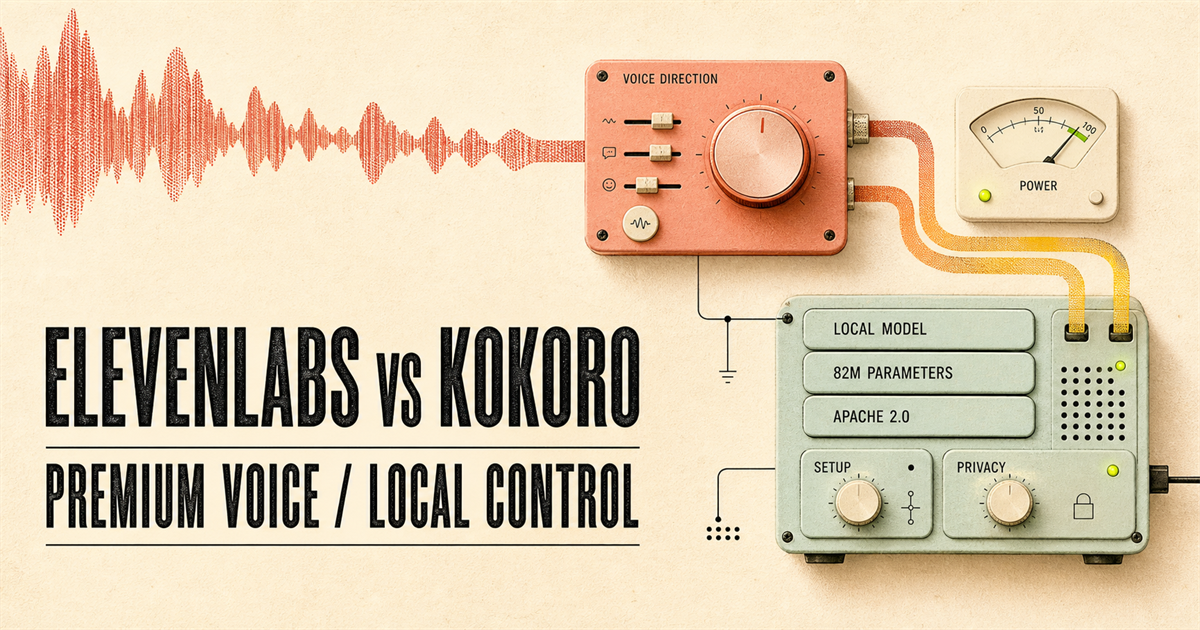
ElevenLabs vs Kokoro is not a fair beauty contest. ElevenLabs is a managed voice platform with a browser studio, APIs, thousands of voices, cloning, and several speech models. Kokoro is a compact open-weight model you can run on hardware you control.
That mismatch is exactly why the choice matters. ElevenLabs sells less setup and a higher creative ceiling. Kokoro removes the per-character meter and can keep text inside your infrastructure. One charges money for convenience. The other charges you in deployment work.
My decision rule is straightforward: choose ElevenLabs when performance, voice choice, cloning, and editor-friendly control shape the final product. Choose Kokoro when local processing, Apache 2.0 weights, predictable high-volume generation, or a small deployment footprint matters more than a polished production desk.
They solve different parts of the job
ElevenLabs gives you a service. A creator can audition voices, change models, adjust delivery, regenerate a line, and export audio without maintaining inference code. A developer gets hosted endpoints, SDKs, streaming, and a product team responsible for model upgrades.
Kokoro gives you a model and a starting point. The official Kokoro model card describes an 82 million parameter model with Apache 2.0 weights. Its basic Python path installs the kokoro package, uses espeak-ng for phonemization, and produces 24 kHz audio. You still need to choose a wrapper, package an endpoint, monitor it, and decide what happens when a long job fails halfway through.
This is the central ElevenLabs vs Kokoro tradeoff. ElevenLabs removes operational work. Kokoro removes vendor dependence. Neither removal is free.
ElevenLabs gives directors more room
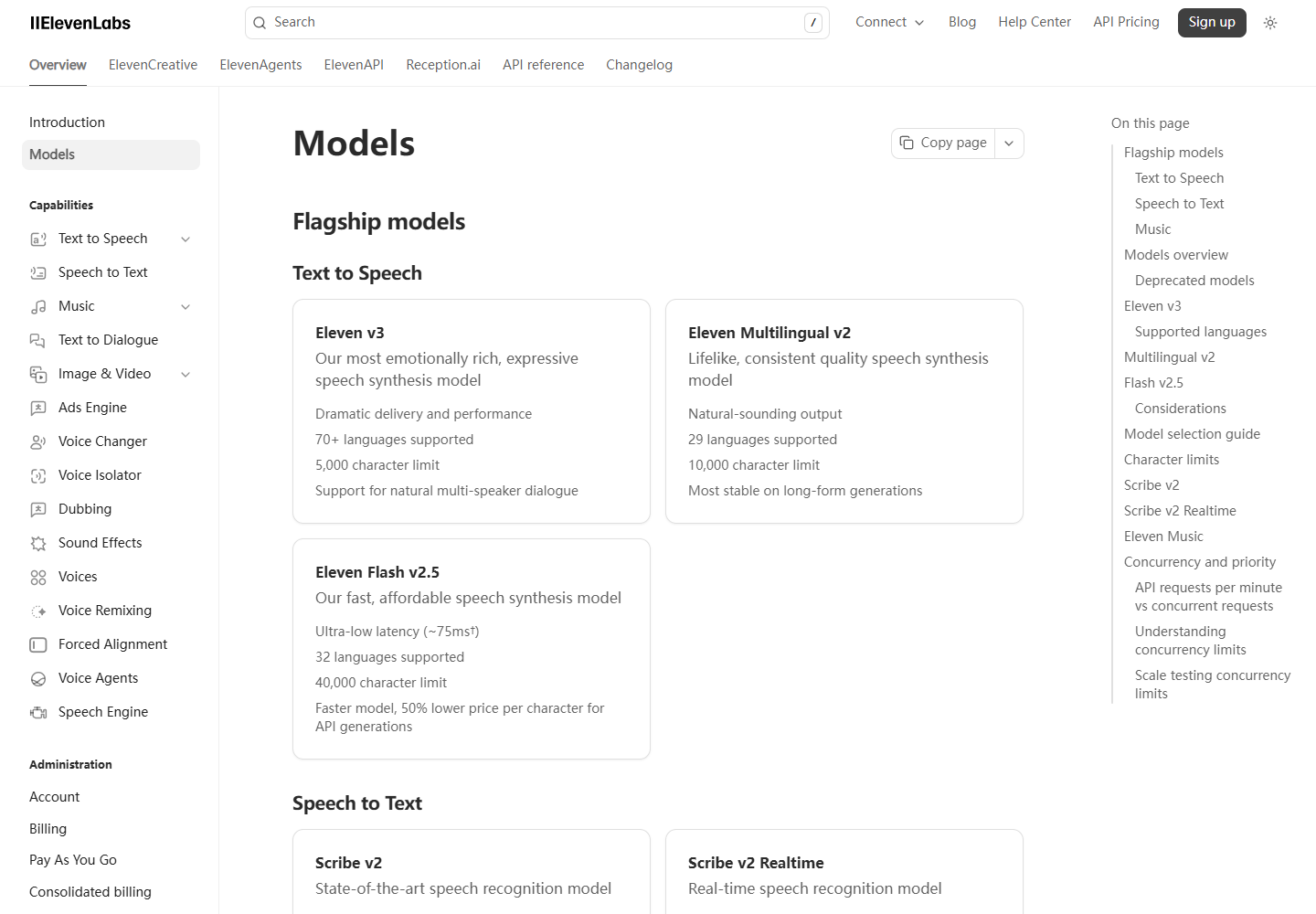
ElevenLabs currently splits text to speech across models with distinct jobs:
- Eleven v3 focuses on dramatic, emotionally rich delivery and supports more than 70 languages.
- Multilingual v2 favors consistent long-form speech across 29 languages.
- Flash v2.5 targets fast interactive speech across 32 languages.
Its larger advantage is the surrounding voice system. ElevenLabs documents a library of thousands of voices, Voice Design, instant voice cloning, and professional voice cloning. That lets a production team start with a catalog, build a consented custom voice, or design a new one without retraining and serving its own model.
More control also creates more decisions. The same line can change when you switch the voice, model, stability setting, pronunciation rule, or surrounding context. The best take proves what the tool can do. The spread between five takes reveals how much editing the project will need.
For a fair trial, use 12 lines that include a name, acronym, date, currency amount, emotional turn, interruption, and a paragraph over 150 words. Generate each difficult line five times. Score pronunciation, pacing, emotional fit, consistency, and repair time. A charming demo sentence does not predict an audiobook chapter.
Kokoro makes local TTS unusually approachable
Kokoro’s appeal starts with its size. At 82 million parameters, it is small enough to appear in CPU, ONNX, browser, and lightweight server projects. The official v1.0 release lists 8 language codes and 54 voice entries. The weights use Apache 2.0, which is far easier to evaluate for commercial deployment than a model with a custom noncommercial license.
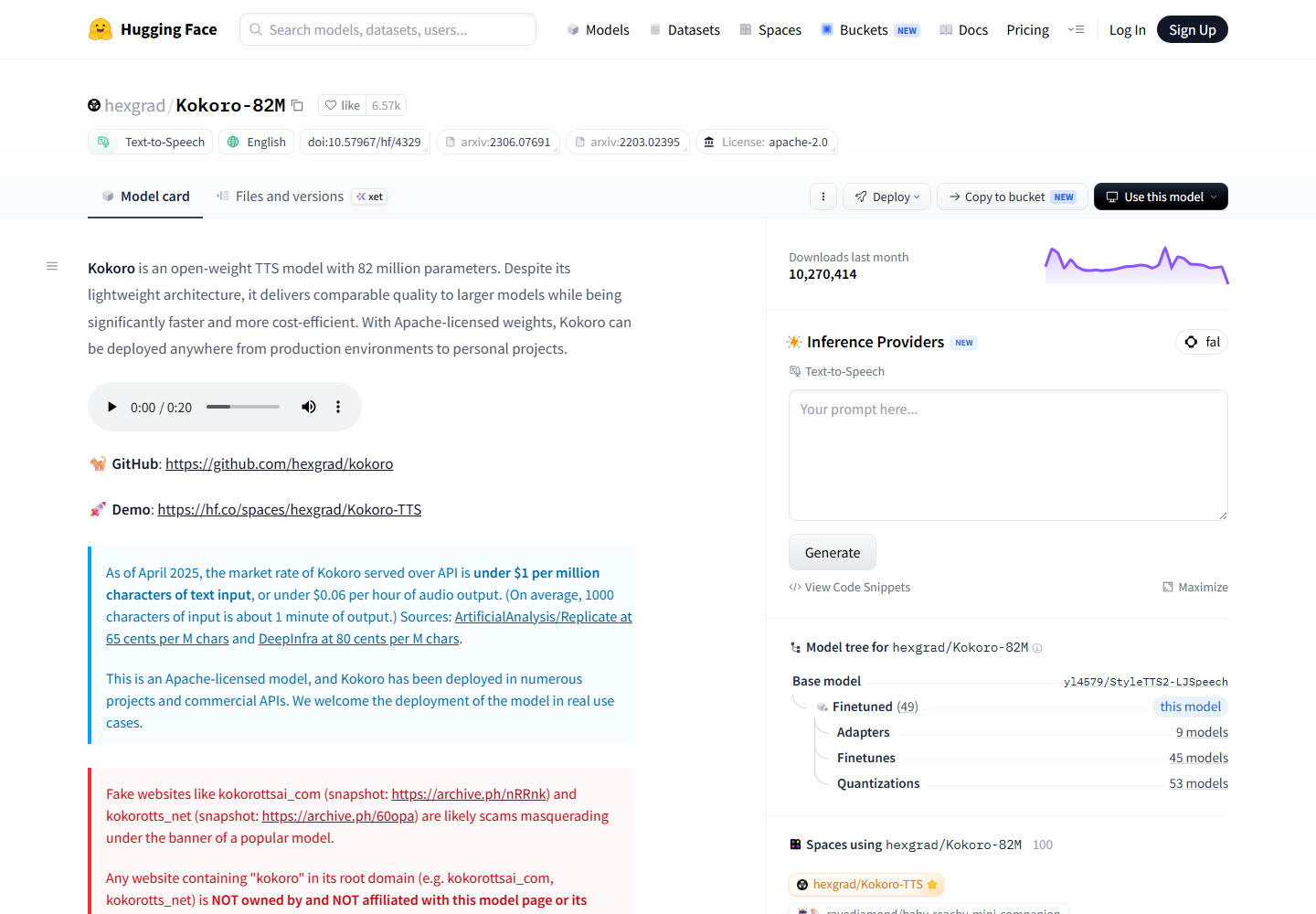
Do not confuse a friendly wrapper with the core project. The model card warns that sites using Kokoro in their root domain are not official or affiliated with the author. Start from the Hexgrad Hugging Face page or the linked GitHub repository, then inspect any wrapper separately.
Kokoro’s small footprint does not turn it into a complete service. A reliable deployment still needs a queue, health checks, request limits, text segmentation, storage rules, logging, and a fallback. If editors need a visual workspace, someone must supply that too.
The model costs nothing to download. Your Saturday afternoon still has a price.
Voice quality and expression
ElevenLabs has the stronger creative ceiling for character dialogue, branded narration, dramatic ads, and multilingual productions. Eleven v3 accepts expressive direction and supports multi-speaker dialogue. Multilingual v2 is the safer long-form option when stable delivery matters more than theatrical range.
Kokoro can sound remarkably natural for its size, especially on clean narration with one of its intended voice packs. It is less convincing as a direct replacement when a project needs wide emotional movement, a specific cloned speaker, or detailed performance direction across several characters.
Reddit reflects that split. In a 2026 open-source TTS discussion, a user testing local models on CPU rated Kokoro the most natural of their small self-hosted set while still placing it below ElevenLabs overall. In an ebook-to-audiobook thread, a Kokoro user found the output acceptable but wanted more emotion and stronger character-to-character intonation.
Those are anecdotes, not a blind listening panel. They tell you what to stress in your own test: emotional turns, dialogue, long paragraphs, and repeated character voices.
Voice cloning is not the same feature
ElevenLabs supports instant and professional voice cloning inside its managed platform. That is a material advantage for authorized brand voices, audiobook narrators, localization, and characters that must remain recognizable across projects.
The official Kokoro release does not provide a general voice-cloning workflow. Its model card says the architecture is decoder-only and that no encoder is released. Voice packs are not the same as uploading a short sample and cloning an arbitrary speaker.
Community projects can add cloning layers around Kokoro, but that changes the software, risk, and maintenance surface. Evaluate the wrapper’s code, license, consent controls, output quality, and release cadence separately. Do not attribute a third-party extension’s feature to the base model.
If cloning is mandatory and you do not want to own that stack, ElevenLabs wins this round quickly.
Languages, pronunciation, and long scripts
ElevenLabs has the broader documented language range. Eleven v3 supports more than 70 languages, while Multilingual v2 and Flash v2.5 cover smaller sets optimized for different quality and speed goals. It also provides pronunciation dictionaries and model-specific control paths.
Kokoro v1.0 lists 8 language codes and 54 voices. That can be plenty for a focused English narration pipeline. It is not a substitute for checking a multilingual catalog line by line. Voice count is also a weak metric by itself. One voice that handles your names, units, and tone beats 50 that fail the script.
For either product, build a pronunciation sheet before the listening test. Include customer names, product names, abbreviations, street addresses, version numbers, and mixed-language phrases. Save every workaround. A tool that requires manual phoneme edits on 3 percent of lines may still be excellent for 20 clips and painful for 2,000 chapters.
Long-form work adds another problem: drift. Split a 20-minute script into sensible sections, keep neighboring context, and compare the first and last minute for timbre, energy, and pace. Kokoro wrappers may segment text differently. ElevenLabs models have different request limits. The wrapper and chunking strategy can change the result as much as the base model.
Setup, privacy, and maintenance
ElevenLabs is faster to put into production. You create an account, choose a model and voice, send text, and receive audio. The service handles model hosting and scaling. The tradeoff is that your text and generation request leave your environment, subject to the vendor’s terms and controls.
Kokoro can keep text and audio on your own workstation or server. That is valuable for offline tools, unpublished manuscripts, internal training, and workflows where an external speech API is not acceptable. Local operation does not automatically make a system secure. You still need access control, encrypted storage, patching, deletion rules, and careful logs.
The maintenance difference becomes obvious during failure. With ElevenLabs, you can inspect vendor status and retry within documented limits. With Kokoro, a failed generation may be your Python environment, phonemizer, model cache, GPU driver, wrapper, queue, or storage layer. More control means more places to look.
For a solo developer, that can be fun. For an editorial team waiting on episode 47, it can be an ambush.
Speed depends on the whole path
ElevenLabs advertises roughly 75 ms of model inference for Flash v2.5, excluding network and application overhead. Kokoro’s compact architecture can run faster than real time on suitable local hardware, but published community figures vary with CPU, GPU, quantization, wrapper, text length, and warm-up state.
Do not compare a vendor’s model latency with a local user’s end-to-end number. Measure the same thing on both sides: time from request submission to the first playable audio byte, plus time until the full file is complete.
For live agents, run at least 50 turns from the target region and record median, p95, and worst-case first audio. Add concurrent requests and interruptions. For batch narration, measure approved audio minutes per hour, including retries. A fast bad take is still a slow workflow.
ElevenLabs vs Kokoro pricing in 2026
I checked the public pricing and model records on July 23, 2026.
ElevenLabs lists pay-as-you-go API rates of $0.05 per 1,000 characters for Flash and Turbo, and $0.10 per 1,000 characters for Multilingual v2 and v3. Its current API page also lists a $6 Starter plan. Text-to-speech usage is metered by character, so retakes and alternate deliveries belong in the budget.
Kokoro’s official weights have no license fee. The model card cites hosted third-party market rates below $1 per million characters as of April 2025, but that is not a guaranteed current price and those providers are separate companies. Self-hosting replaces the API bill with compute, storage, monitoring, engineering, and support costs.
Price a real batch, not a clean demo. For 100 finished narration minutes, track input characters, rejected takes, editor time, infrastructure time, and hardware or service spend. Then calculate cost per approved minute. That number exposes both an expensive API and an expensive hobby project.
What people complain about on Reddit
The common Kokoro complaint is not that it never sounds good. It is that the base model stops short of the surrounding product people expect.
In a LocalLLaMA discussion about Kokoro’s small size, users repeatedly asked about voice cloning and distinguished the curated voices from a released arbitrary-speaker cloning system. A self-hosted ElevenLabs replacement thread also showed how quickly “replace the TTS” expands into telephony, speech recognition, an LLM, retrieval, tools, and orchestration.
Cost is the recurring ElevenLabs complaint. An n8n user who moved to a local Kokoro endpoint framed the switch around per-character spend and privacy. The comments then surfaced the tradeoff: documentation questions, cloning requests, language needs, and the missing pieces of a full voice agent.
Reddit is good at revealing chores that landing pages omit. It is bad at producing a universal quality ranking. Treat these complaints as a test plan, not a verdict.
Who should choose ElevenLabs
Choose ElevenLabs if:
- You produce character dialogue, audiobooks, localized media, ads, or branded narration.
- Voice cloning or a large audition library is a hard requirement.
- Writers and editors need a usable workspace without maintaining inference infrastructure.
- Broad language support and several model choices matter more than local control.
- Paying per character is cheaper than owning deployment, monitoring, and support.
Skip it if text cannot leave your environment, offline operation is mandatory, or a recurring usage meter breaks the economics of a high-volume, simple narration job.
Who should choose Kokoro
Choose Kokoro if:
- You need local or offline text to speech.
- Apache 2.0 weights fit your legal and commercial requirements.
- Your scripts fit Kokoro’s languages and existing voices.
- You can package Python or ONNX inference and maintain the service.
- High generation volume makes a self-hosted pipeline worth the engineering time.
Skip it if a nontechnical team needs a finished studio, an approved cloned voice, vendor support, broad multilingual coverage, or a service-level agreement. A model can be excellent and still be the wrong product.
Who should avoid both
Avoid both when your real bottleneck is editing, captions, timeline repair, or video export. A full audio and video editor may save more time than either TTS engine.
Also pause if you do not have clear permission to clone or imitate a speaker. Better tooling does not fix missing consent. For regulated or sensitive material, have your legal and security teams review the complete data path, not just the model license.
My verdict
ElevenLabs wins when the voice is part of the product. Its expressive models, cloning options, catalog, and managed workflow justify the premium for teams that care about performance and speed to publication.
Kokoro wins when local control is the requirement. Its compact 82M-parameter model and Apache 2.0 weights make private, high-volume speech unusually accessible, as long as you budget for the work that a hosted platform normally hides.
For most creators, I would test ElevenLabs first. For developers building a focused English narration tool, private reader, or offline feature, I would prototype Kokoro first. Run the same difficult script through both, count every repair, and price only the audio you would actually publish.
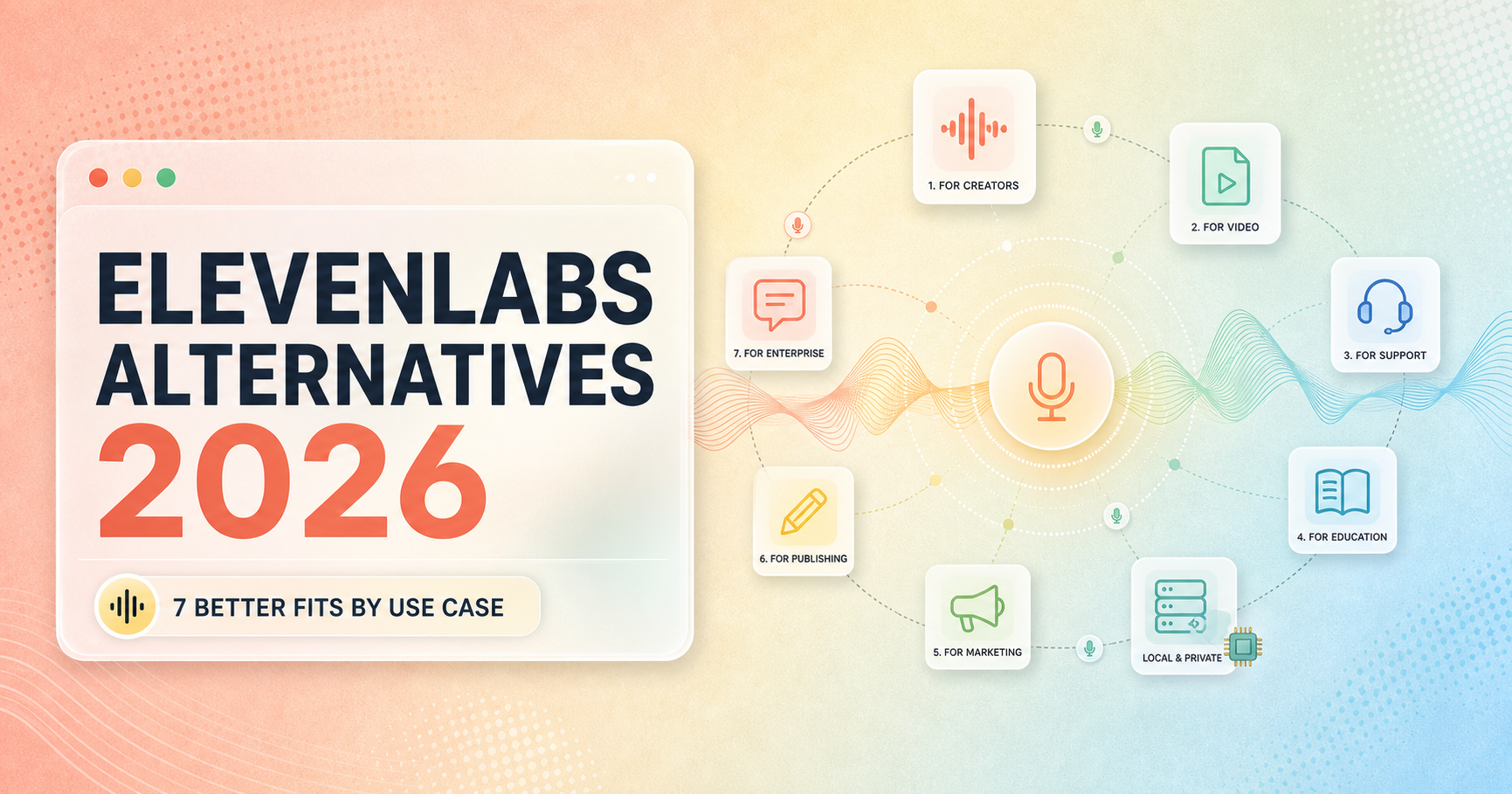
If neither side fits, continue with my ElevenLabs alternatives 2026 guide. It compares creator suites, real-time APIs, cloud platforms, and local models by the work they remove, not by the size of their voice menu.